
Cultural Competitiveness Diagnostic
Is your culture built for the competition you actually face?
The DCC turns culture into actionable strategic conversation — with data. Discover, by segment, where your culture is a lever or an obstacle to strategy.
10-minute questionnaire·100% anonymous·Read by area, level, and tenure
For C-levels
The DCC in a few minutes.
Why culture must become data — and how the DCC delivers that to the board.
The problem
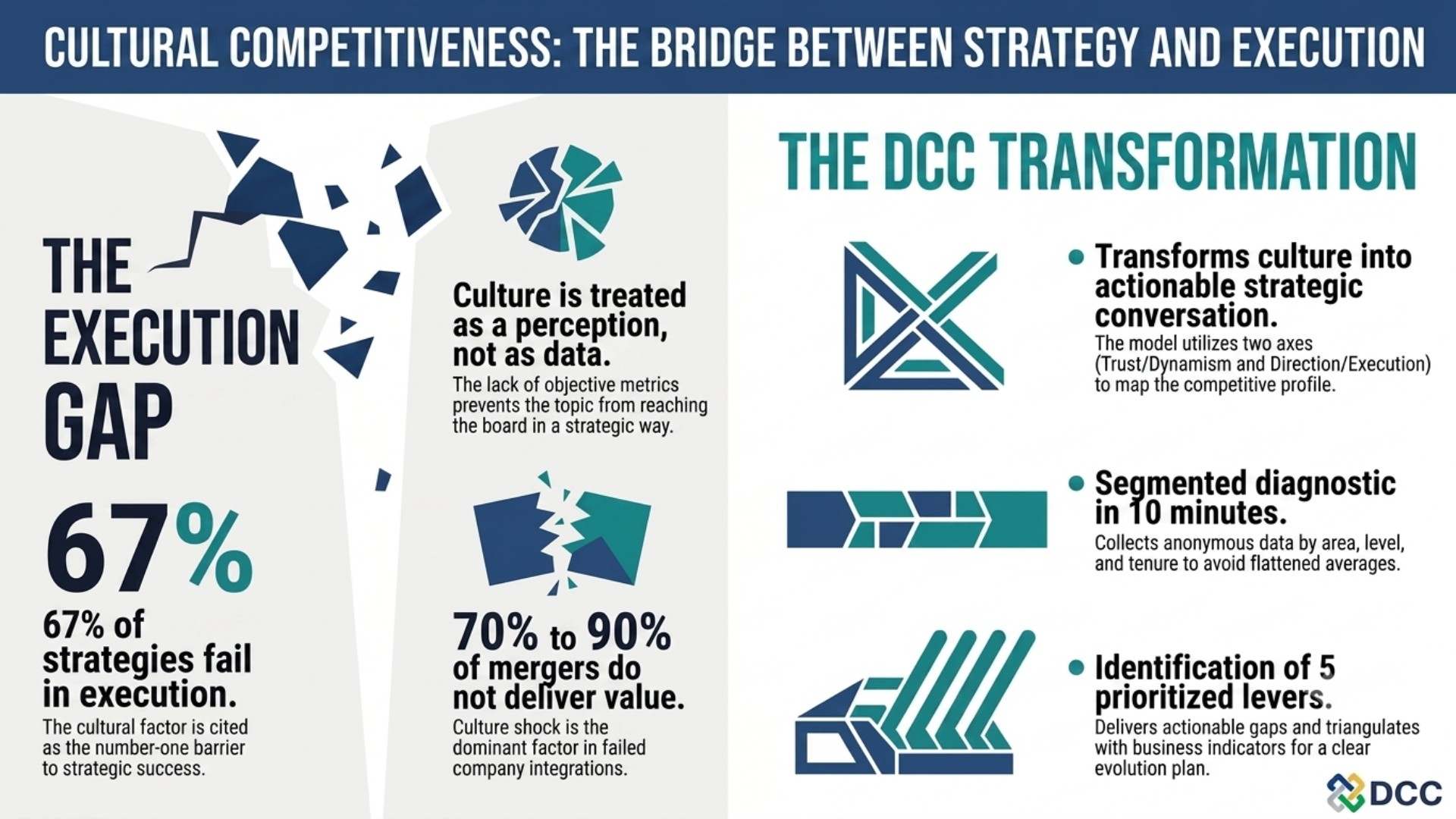
Strategies don't fail because they're wrong. They fail because the culture doesn't execute them.
And the reason is rarely technical — it's cultural. The problem is that "culture" tends to be a conversation about perception, with no data to take to the board.
of mergers fail to deliver the expected value. The dominant factor is cultural.
Harvard Business Review · McKinsey
of well-formulated strategies fail in execution. The #1 barrier is cultural.
Kaplan & Norton · MIT Sloan
The landscape
From the execution gap to the DCC transformation.
The model
Two axes. Four profiles.
The DCC positions your culture on two axes that determine competitive capability — and maps it to one of four profiles.
Trust Culture
Trust and dynamism — lacking direction. Strong in innovation and agility; risk of dispersion.
Competitive Culture
Clear direction + dynamism. Combines strategic focus with adaptation.
Stability Culture
Predictable and solid — low dynamism. Reliable; risk of rigidity in the face of change.
Execution Culture
Discipline and focus — lacking trust. Strong in delivery; risk of burnout and low adaptability.
The key
There is no universally better culture.
The DCC doesn't say "climb to the top." It tells you whether your culture is an asset or a risk to YOUR strategy and YOUR market — and how urgent it is to act. A stable culture can be ideal in a calm market; and a fatal trap in a market under disruption.
How we measure
Six sub-dimensions
Each axis breaks down into three sub-dimensions, anchored in recognized culture and performance models.
Direction & Execution
Strategic Clarity
Strategy is understood and aligned at every level.
Direction & Execution
Execution Speed
Speed and discipline in decision-making and implementation.
Direction & Execution
Results Orientation
Focus on measurable outcomes and accountability.
Trust & Dynamism
Systemic Trust
An environment that enables autonomy, initiative, and calculated risk.
Trust & Dynamism
Organizational Adaptability
Ability to reconfigure and respond to the market.
Trust & Dynamism
Innovative Dynamism
A culture of experimentation and continuous improvement.
What you take away
- Where your culture helps or blocks strategy.
- The fit (or misfit) with your competitive context.
- Gaps by area, level, and tenure — actionable.
- 5 prioritized levers + baseline to remeasure.
How it works
- Online questionnaire, 10 min, 100% anonymous.
- Read by segment — not a flat average.
- Triangulation with business indicators.
- Leadership debrief + evolution plan.
Next step
Ready to see where your culture stands?
A 30-minute conversation to tailor the application to your context. No commitment.